
BYD Seal 08 vs. Venucia D60 EV Plus: A Crash That Speaks Volumes
As BakuWheels, we closely follow real-world safety incidents that reveal the true character of modern vehicles — and a collision captured on dashcam footage in China on July 14, 2026 has become one of the most talked-about crash stories of the year.
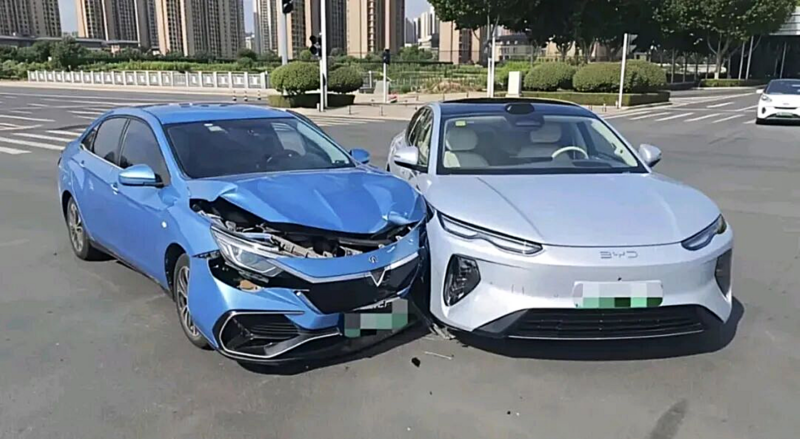
A BYD Seal 08 was involved in a collision with a Venucia D60 EV Plus, and the outcome was startling in its contrast: the BYD walked away with nothing more than minor fender scuffs, while the Venucia suffered severe front-end damage.
What Happened on the Road?
According to reports published on July 14, 2026, and verified by CarNewsChina, the incident occurred in China at what appears to be an intersection. Dashcam footage and post-accident photographs circulated rapidly across Chinese automotive forums and social media platforms.
The images tell a compelling story: the BYD Seal 08 — BYD's flagship plug-in hybrid SUV — showed only superficial damage to its front fender, with paint scuffs and minor bodywork blemishes. In sharp contrast, the Venucia D60 EV Plus had its entire front end severely crumpled, with the hood buckled, the front fascia destroyed, and significant structural deformation visible.
About the Venucia D60 EV Plus
The Venucia D60 EV Plus is an electric sedan produced under the Venucia (启辰) brand — a joint venture between Dongfeng Motor and Nissan. It is based on the same platform as the Nissan Sylphy (Sentra) and is primarily sold in the Chinese domestic market as an affordable electric family sedan.
While the Venucia D60 EV Plus is a relatively contemporary vehicle and not an aged legacy car, it represents the more budget-oriented end of China's new energy vehicle spectrum. Its body structure and crash management systems are designed to more modest engineering and cost targets compared to BYD's flagship PHEV platforms.
Key specifications of the Venucia D60 EV Plus:
- Powertrain: Pure electric motor
- Platform: Based on Dongfeng-Nissan Sylphy architecture
- Segment: Compact affordable electric sedan
- Market: China domestic
This is a critical distinction: the Venucia D60 EV Plus is a modern electric vehicle — not a legacy nameplate or an aged model. This makes the structural outcome of this crash even more noteworthy and directly relevant to today's EV safety conversation.
Engineering Behind the Outcome
This outcome is highly significant precisely because both vehicles are modern EVs and PHEVs — yet the difference in structural performance was dramatic. The BYD Seal 08 is built on BYD's advanced e-Platform 3.0 architecture, which integrates the battery pack as a structural element of the vehicle's floor — a design philosophy that significantly enhances the rigidity and crashworthiness of the body-in-white.
The BYD Seal 08 is equipped with BYD's proprietary Blade Battery technology, which not only improves energy density and thermal stability but also contributes meaningfully to the car's structural stiffness. The vehicle uses high-strength steel and advanced crumple zone engineering designed to absorb and redirect impact energy away from the passenger cabin.
The Venucia D60 EV Plus, while a contemporary vehicle, is built to a different cost and engineering standard. Its platform — derived from the Nissan Sylphy — was not conceived with the same level of structural integration that BYD's purpose-built e-Platform 3.0 delivers. This real-world incident exposes the performance gap that can exist even between two modern EVs when their engineering philosophies and investment levels differ substantially.
BYD Seal 08 — A Brief Overview
The BYD Seal 08 has quickly established itself as one of China's most sophisticated plug-in hybrid SUVs. Positioned as a premium family SUV, it is powered by BYD's fifth-generation DM (Dual Mode) hybrid system, delivering a combined system output that makes it both highly efficient and genuinely performance-capable.
Key specifications of the BYD Seal 08:
- Powertrain: 5th-generation DM hybrid system with 1.5L turbocharged engine
- Pure Electric Range: Over 100 km (CLTC)
- Total System Power: Up to 321 kW
- 0–100 km/h: Under 5 seconds (high-performance variant)
- Safety Architecture: e-Platform 3.0 with integrated Blade Battery structure
- Segment: Full-size premium PHEV SUV
The vehicle competes in the upper-mid segment of China's rapidly maturing new energy vehicle market.
Public Reaction in China
The footage sparked significant debate online across China. Many netizens praised BYD's structural engineering and used the incident to reinforce confidence in domestically produced electric and hybrid vehicles. A notable portion of commentary, however, focused on the fact that the Venucia D60 EV Plus is itself a modern EV — meaning this crash cannot be dismissed as simply a new-car-versus-old-car scenario.
Some automotive commentators pointed out that the size and weight disparity between the two vehicles also played a role — the BYD Seal 08 is a significantly larger and heavier SUV compared to the compact Venucia D60 EV Plus sedan — and that mass differential in collisions inherently favors the heavier vehicle regardless of its construction quality.
The Broader Safety Conversation
As an expert automotive journalist, I would caution against drawing absolute conclusions from a single real-world incident. Crash test laboratories use controlled, repeatable conditions precisely because road accidents involve countless variables — speed, angle of impact, road surface, and vehicle loading conditions all affect outcomes.
However, this incident does serve as a powerful reminder that not all EVs are created equal from a structural standpoint. BYD, in particular, has invested heavily in passive safety as a competitive differentiator in the global market, and incidents like this demonstrate that engineering investment in structural integrity pays real-world dividends.
For consumers in Azerbaijan and the broader Caucasus and Central Asian markets where BYD vehicles are growing in presence, this real-world crash footage reinforces the brand's safety credentials in a way that laboratory test scores alone sometimes cannot.
BakuWheels Verdict
The BYD Seal 08 vs. Venucia D60 EV Plus incident is a striking illustration of how structural engineering philosophy and investment levels can differentiate even two modern electric and hybrid vehicles. It is a timely reminder that the EV label alone does not guarantee superior crashworthiness — platform architecture, material selection, and engineering ambition matter enormously.
For prospective buyers considering modern Chinese NEVs, this is one more data point suggesting that BYD's engineering commitments extend well beyond marketing claims.
BakuWheels will continue to monitor safety developments across all major automotive brands and bring you the most informed and fact-checked analysis from the world of wheels.